
The Twelfth Imam
The Twelfth Imam
Font size setting
+ Add to your favorite list

Article ID: 43
Article Date: 2016-09-10
Writer: Mostafa Amiri (http://rajanews.com/node/254450)
The world awaits the Damascus earthquake/Is the Damascus earthquake from "Jabiya" in the Golan Heights in occupied Palestine to "Harasta" in Syria real?
In the series of articles on Mahdism studies, efforts will be made, relying on Islamic traditions and narrations, to present a complete, coherent, and rational picture of the definite signs of the Reappearance and the related events. The least outcome of this effort is that researchers will be able to distinguish authentic material from unauthentic in the discussions on Mahdism and, in the position of judgment and analysis, refrain from relying on unauthentic material.
In the fifth article, reference was made to the jurisprudential obligation of recognizing the definite signs of the Reappearance. And in the sixth article, the question was answered whether in the signs of the Reappearance, and especially in the definite signs such as the Yemeni, the Sufyani, and so on, the possibility of badaʾ—change or even non-occurrence—exists or not.
And in the seventh article, the great importance of the uprising of the Sufyani, as the greatest enemy of the Imam of the Age and the first definite sign of the Reappearance—which in some way all the definite signs of the Reappearance are connected to this sign— was addressed, and to this important point reference was made that one of the fundamental goals of the uprising of the Sufyani is the attack on Shiʿa-inhabited regions, the killing of the Shiʿa, and the assault on the holy Shiʿa centers in the land of Iraq. And the impact of this great event on the very existence of Shiʿism, and the threat that from the direction of the Sufyani targets the Shiʿa of the world, makes it necessary to examine the dimensions of this affair and to be aware of its various aspects.
In the eighth article, we introduced the characteristics of the first definite sign of the Reappearance, the Sufyani, its wide-ranging dimensions, and its relation to the events of Syria in the end times and the region of al-Sham.
And in the ninth article, the question was answered whether the Sufyani is symbolic or real. In other words, can the Sufyani be regarded as a symbol of the ruling mentality and the current opposed to Shiʿism? Or, while being considered an anti-Shiʿa current within the Islamic world, it is by no means improbable that the leader of this current would be an actual person from the family of Abu Sufyan. In the tenth article, we will elaborate on the personal, physical, and individual attributes of the greatest enemy of the Imam of the Age.
In the eleventh article, reference was made to the religion, creed, and inclination of the Sufyani toward the Western world, and the joint military pact of the Sufyani with Western civilization.
In the twelfth article, reference was made to the time of the emergence of the Sufyani in the year of the Reappearance of Imam Mahdi, and to the uprising of the Yemeni and the Khurasani, and for the first time the correct meaning and interpretation of the simultaneous emergence of these three movements (the Khurasani from Iran and the Yemeni from one side, and the Sufyani on the other side) in the Islamic world was explained.
In the thirteenth article, the period between the emergence of the Sufyani in the month of Rajab in Syria until the uprising of the Imam of the Age on ʿAshura of the month of Muharram from Mecca, and the fifteen-month interval between the emergence of the Sufyani and the Reappearance of the Imam of the Age, was established, and also reference was made to the difference between the Reappearance, the uprising, and the emergence of the Imam of the Age.
In the fourteenth article, the golden key to recognizing the Sufyani—the last ruler of Syria—and the support of the Banu Kalb clan for him, as well as the place and beginning of the probable coup of the Sufyani against the ruler of Syria in the year of the Reappearance, from the area of Wadi Yabis and the province of Daraa in southern Syria, was explained in detail, and it was also mentioned that the reference to the name ʿUthman may be an allusion and symbolic.
In the fifteenth article, reference was made to the military entry of the yellow-colored flags from the west of al-Sham into the field developments of the Syrian war, and it was also proven therein that before the Appearance, the military forces of Western countries will not enter the capital of Syria, Damascus, and that, in principle, the Westerners will not have direct military intervention in Damascus and the heart of Syria before the Appearance.
As mentioned in the previous discussion, Imam Ali (PBH) and Imam Muhammad al-Baqir (PBH) narrated two detailed hadiths regarding the sequence of events before the Appearance of Imam al-Mahdi (PBH). By putting together the contents of these two narrations, the order of events can largely be anticipated:
Hadith of Imam Ali (peace be upon him):
“When two armies in the region of al-Sham and Syria engage in war, one of the great signs of God will appear, and that is an earthquake in the region of al-Sham and Syria, in which more than one hundred thousand will perish. For the believers, it will be mercy, and for the disbelievers, punishment. Then expect the entry of military forces with yellow banners from the west of Syria (Lebanon) and war machines equipped with projectile-launching weapons, which will enter the land of al-Sham and Syria … Then expect the earthquake and swallowing by the earth in the area of Harasta in Damascus, Syria. After that, await the emergence of Sufyani, the son of Hind the Liver-eater, who will emerge from Wadi Yabis (the border between Jordan and Syria in the province of Darʿa) to seize Damascus. After that, await the uprising of the Imam al-Mahdi" (1)
Hadith of Imam Muhammad al-Baqir (PBH):
“… A cry will be blown over Damascus along with victory, and an earthquake will occur in the area of Jabiya of Damascus in Syria, and part of the Umayyad Mosque of Damascus will be destroyed … Then, forces will emerge on the part of the Turks (the claim of independence of the Kurdish regions of Syria); sedition, conflict, and killing will encompass the Romans (Western countries). The brothers, the Turks, will maintain their military presence in the Syrian Jazira (the Syrian Jazira refers to the areas connected to the Iraqi border, including al-Hasakah, Dayr al-Zur, and al-Raqqa in eastern Syria); and forces from the Romans will also deploy troops in Ramla (the port of Ashdod in occupied Palestine). In that year, sedition and conflict will spread across all Arab lands. And the first land to be destroyed will be the land of al-Sham(Syria) … .” (2)
After the discord in the land of al-Sham and the war and bloodshed between the forces engaged in the Syrian front (when two armies engage in battle in the region of al-Sham and Syria), and after the loud sound over Damascus (A loud sound will be blown over Damascus along with a conquest) and the earthquake that will be a mercy for the believers and a punishment for the disbelievers in the region of al-Sham (and this earthquake in the region of al-Sham and Syria will cause more than one hundred thousand deaths, which will be mercy for the believers and punishment for the disbelievers), and after the arrival of advanced war machines to Syria and the change in the balance of power between the two opposing sides (and war machines equipped with projectile weapons), as well as the entry of yellow-colored flags from the west of Syria (awaiting the entry of military forces with yellow-colored flags), in the next stage, before the emergence of the Sufyani, the world will be awaiting the earthquake and sinking of the ground in Damascus along the Jabiyah-Harasta axis (and an earthquake will occur in the Jabiyah area of al-Sham), which will cause part of the Umayyad Mosque of Damascus to collapse (and part of the Umayyad Mosque of Damascus will be destroyed). In the next stage, the Kurdish claim for separation from the rule of al-Sham and Syria will occur (Then, those coming from the Turks will emerge), but it will not take long before this Kurdish aspiration is confronted by the Turkish attack on the Kurdish regions in northeastern Syria (the Turkish brothers continue the presence of their military forces in al-Jazira of Syria). It should be noted that all these events occur before the rise of the last ruler of Syria in the Age of Appearance (the Sufyani).
As mentioned, in the sequence of events “before the emergence of the Sufyani” in the region of al-Sham and Syria, a “sinking of the ground” (land subsidence) will occur in an area of Syria centered along the axis from Jabiyah to Harasta near Damascus. Although in some hadiths the exact location of the sinking of the ground and the Damascus earthquake is not specified:
“…A city among the cities of al-Sham will sink into the ground, and part of the mosque of al-Sham (the Umayyad Mosque of Damascus) will collapse…”(3)
However, in other hadiths, the place of occurrence of the sinking of the ground is clearly and explicitly stated; including the aforementioned narrations from Imam Ali and Imam al-Baqir.
Then, part of the wall of the Umayyad Mosque of Damascus will collapse, indicating the very near emergence of the Sufyani:
“…and part of the Umayyad Mosque of Damascus will be destroyed… and after that, await the emergence of the Sufyani, the son of Hind the Liver-Eater, who will emerge from Wadi Yabis (the border between Jordan and Syria in the Daraa Governorate) to reach Damascus, and after that, await the rise of the Imam Mahdi…”
The Umayyad Mosque of Damascus in Syria is an ancient mosque with extensive artistic features, built by the order of Walid ibn Abd al-Malik (d. 96 AH), one of the Umayyad caliphs in Damascus. The maqams (shrines) of Prophet Khidr, Hud, and Yahya, as well as the maqam of Imam al-Sajjad and the head of Hussein, are well-known in this mosque. The sermon of Imam al-Sajjad (PBH), which illuminated the incident of Karbala, was also delivered in this mosque. (4)
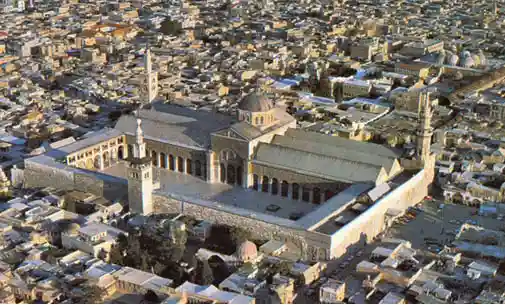
In the End Times, it will again become the scene of significant events, and according to Shia and Sunni hadiths, before the emergence of the Sufyani, during the land subsidence in Jabiyah, parts of the Umayyad Mosque of Damascus will also collapse.(5)

The Umayyad Mosque of Damascus, more than a thousand years old, in Syria
Considering that in the two aforementioned hadiths, the location of the ground sinking and the earthquake in Damascus is referred to two different areas, does this cause a contradiction?
In reality, there is no contradiction, because by observing the geographical map of the Jabiyah and Harasta areas, these locations are very close to each other, with a distance of about 10 kilometers. In events such as earthquakes, the epicenter is usually a specific area, and the effects spread within a limited radius depending on the strength of the earthquake.
Therefore, in fact, the central point of the ground sinking and the Damascus earthquake is the “Jabiyah–Harasta axis.” As a result of this natural event, parts of the Umayyad Mosque of Damascus will collapse, as explicitly stated in the hadith. This mosque is located near the Jabiyah area.

Jabiyah-Harasta axis and Umayyad Mosque in Damascus
A question that may arise is that Jabiyah in Syria and al-Sham can refer to two different locations: “Jabiyah, Syria,” near Damascus, and “Jabiyah of the Golan,” near Palestine, both of which are in the historical region of al-Sham. Which location is intended in the hadith of Imam al-Baqir? Apparently, the reference is to Jabiyah near Damascus and the Umayyad Mosque, since the noble hadith of Imam Muhammad al-Baqir explicitly mentions the destruction of the Umayyad Mosque. This mosque is located near the Jabiyah area of Damascus, not Jabiyah of the Golan.
Therefore, the view of some who consider the earthquake line in Syria to extend from Jabiyah in the Golan near Palestine to Harasta, Damascus, does not seem correct. The collapse of the Umayyad Mosque of Damascus due to the intensity of the earthquake indicates that the Jabiyah mentioned actually refers to the Jabiyah area near the Umayyad Mosque of Damascus, not Jabiyah located in the Golan on the Syria–Palestine border; moreover, Jabiyah of Damascus is much closer to the Harasta area (about 10 kilometers).
Of course, these events are not exclusive to Shia hadith sources; the theme of the sinking of the ground in Harasta, Syria, is also mentioned in numerous Sunni hadiths:
“…The ground shakes, and the western side of the mosque sinks into the ground, and the settlement called Harasta sinks into the ground, and after that, the Sufyani emerges…” (6)
“…(Imam) Mahdi will not emerge until the settlement in Ghouta, called Harasta, sinks into the ground.” (7)
“…And after the sinking of the ground and the subsidence of an area in Damascus and the collapse of the western part of the mosque of Damascus, three flags will be raised in the region of al-Sham:
Abqa’, As-hab, and Sufyani…” (8)
From Ammar Yasir, a companion of the Prophet, in the book Al-Ghaybah by Sheikh Tusi, citing Sunni sources, it is also narrated:
The rule of the Prophet’s household in the End Times has signs, among which are: “…and a caller in Damascus will announce: ‘Woe to the people of the Earth from the evil that has approached,’ and the western part of the Umayyad Mosque of Damascus will sink into the ground, so that its wall is destroyed and ruined. In al-Sham, three will rise, all seeking governance and authority: Abqa’, As-hab, and Sufyani. The Sufyani emerges from the region of Kalb (southern Syria) and gathers people in Damascus…” (9)
Similar narrations are mentioned by other Sunni scholars, including Muqaddas Shafi’i in ‘Aqd al-Durar fi Akhbar al-Muntazar (= Collection of Precious Pearls on the News Concerning Imam Mahdi) (10), and also by Abu Amr Dani in Al-Sunan al-Waridah fi al-Fitan (= Hadiths and Narrations Concerning End-Time Events) (11).
Will the sinking from the Jabiyah to Harasta axis in Damascus, Syria, cause major transformations? The hadiths do not mention the extent of damage and destruction from the sinking of the ground and the “Jabiyah–Harasta earthquake in Damascus, Syria.” However, since the sinking and earthquake are natural events, affecting a limited area up to a radius of 10 kilometers, it naturally does not cover a large area. Therefore, it will not result in fundamental changes or field-level consequences in the conflict between the two groups in al-Sham and only serves as a sign indicating the imminent emergence of the Sufyani. (12)
The exact timing of the sinking and the Damascus earthquake is not specified, but events before and after it are mentioned in detail in the hadith of Jabir from Imam al-Baqir. In Sunni sources, a hadith narrated from Imam Ali provides a general, not precise, timing:
“When the black flags of falsehood in the region of al-Sham dispute among themselves, await the sinking of the ground and the Harasta earthquake in Syria, and after that, three flags will appear in the region of al-Sham.” (13)
Thus, when the black flags of falsehood in al-Sham and Syria are in discord, we will be approaching the Damascus earthquake, though no definitive conclusion can be drawn from this hadith, as its content is not present in Shia hadiths from the Infallible Imams.
Although Shia sources do not precisely specify the timing of the sinking and the Damascus earthquake, they do describe the events before and after it. Therefore, they provide a good criterion for anticipating and preparing for the Appearance of Imam Mahdi (PBH).
Specifically, after the discord in the land of al-Sham and the war and bloodshed between the forces on the Syrian front, after the arrival of advanced war machines to Syria and the shift in the balance of power between the two opposing sides, and after the entry of yellow-colored flags from western Syria, the world in the Age of Appearance will be awaiting the Damascus earthquake along the Jabiyah–Harasta axis, which will cause parts of the Umayyad Mosque of Damascus to collapse.
The sinking of the ground and the Damascus earthquake themselves serve as a sign for subsequent events before the emergence of the Sufyani, including the completion of the Kurdish independence movement in Syria and the subsequent Turkish attack on Syria. Therefore, although these events may appear ordinary like many natural disasters and may not cause widespread casualties, they will act as a sign for subsequent events prior to the rise and governance of the last ruler of Syria (the Sufyani) in the Year of Appearance.
Therefore, the sequence of events will be as follows:
Although until now the Jabiyah–Harasta sinking in Syria has been interpreted as an earthquake, does "Khasf" really mean earthquake, or are other possibilities considered? From the perspective of most researchers, "Khasf" in Syria is understood as "earthquake," while some interpret it as "ground subsidence" in Damascus. However, whether the term "Khasf" in the hadith should mean earthquake, and whether the subsidence of the ground in the area where the earthquake occurs qualifies, cannot be stated with certainty. Ground subsidence is more specific than an earthquake; not every earthquake leads to subsidence or destruction. If an earthquake does result in destruction, it may be termed "Khasf." Many earthquakes occur without causing significant destruction, only resulting in land shifts. Yet the common factor between Khasf and earthquake is that both originate from the depths of the earth.
Therefore, the meaning of the word "Khasf" in areas of Damascus, Syria (Jabiyah and Harasta) before the emergence remains ambiguous, like the word "tremor." Does the sinking of the ground in Jabiyah–Harasta before the emergence of the Sufyani mean an earthquake, land subsidence, or excavation/destruction of the earth’s surface due to an explosion? In any case, it indicates an event on the earth's surface along the Jabiyah–Harasta axis near Damascus in Syria. Hence, it is appropriate for those awaiting the Appearance of the Imam of the Age to use the term "Khasf of Damascus" instead of "Damascus earthquake," as in the hadith, to avoid misunderstanding the narrations of the Ahl al-Bayt; although the majority of scholars of Mahdism consider it an earthquake in Damascus. (14)
After studying this text, the following conclusions can be drawn:
Based on detailed hadiths from Imam Ali (PBH) and Imam Muhammad al-Baqir (PBH), after discord between two opposing factions in al-Sham and Syria, following bloodshed and war, the earthquake of al-Sham, the arrival of advanced war machines in Syria, and the shift in the balance of power between the two sides, as well as the entry of military forces with yellow flags from western Syria, the world during the Age of Appearance will await the Damascus earthquake. The "Khasf of Damascus" along the Jabiyah–Harasta axis will occur during discord between the two opposing factions in Syria at war with each other, and its sign will be the destruction of areas along the Jabiyah–Harasta axis, as well as damage to parts of the Umayyad Mosque of Damascus. Following this, the claim of "Kurdish independence in Syria" will arise, but it will not last long before facing a "Turkish attack."
Although the majority of Mahdism scholars interpret "Khasf" as an earthquake, some interpret it as ground subsidence. Whether the term "Khasf" in the hadith should strictly mean earthquake, or whether subsidence counts as an earthquake, cannot be conclusively stated. Therefore, the term "Khasf" in areas of Damascus, Syria (Jabiyah and Harasta) before the emergence remains ambiguous, like the word "tremor." In any case, it indicates an event on the surface of the earth along the Jabiyah–Harasta axis near Damascus, Syria. It is thus recommended for those anticipating the Imam of the Age to use the phrase "Khasf of Damascus" instead of "Damascus earthquake," to avoid misunderstandings in interpreting the Ahl al-Bayt narrations, though most Mahdism scholars rely on the occurrence of an earthquake in Damascus, Syria.
The Khasf and earthquake of Damascus themselves serve as a sign for subsequent events, including the completion of the Kurdish independence movement in Syria and the subsequent Turkish attack on Syria. Although these events may appear ordinary like many natural disasters and may not result in widespread casualties, they are a sign of the events leading up to the emergence and governance of the last ruler of Syria (the Sufyani) in the Year of Appearance.
If the events in al-Sham and present-day Syria occur in the order mentioned in the hadith of Imam al-Baqir, with a “specific time interval,” and are scientifically and reliably corroborated by authentic hadiths, this will signify entry into the transformational events of the Age of Appearance in Syria, placing responsibilities upon the Shia; thus, recognizing these signs becomes obligatory.
Finally, these series of articles and studies have examined the end-time events in Syria "before the emergence of the Sufyani" from a future studies perspective. Without any arbitrary judgment, we await the changes and transformations mentioned in the hadith of Imam al-Baqir, known as the “Hadith of Tamhid Mubashir.” It is worth noting that the occurrence of all the events mentioned in the hadith of Imam al-Baqir in Syria, in a specific time sequence, constitutes three fundamental and key conditions for entering the transformations of the Age of Appearance. Otherwise, if any of these three key conditions are not met, any premature judgment or hasty attempt to apply the hadith is completely incorrect. As emphasized in the narrations from the Ahl al-Bayt:
“…Those who hasten in the matter of the Appearance will be destroyed, while those who consider the Appearance near will be saved.”(15)Footnote
1 - Nu‘mani, Al-Ghaybah (The Occultation of the Imam), p. 305; Sheikh Tusi, Al-Ghaybah (The Occultation), p. 461; Majlisi, Bihar al-Anwar (Oceans of Lights), vol. 52, p. 253.
2 - Nu‘mani, Al-Ghaybah (The Occultation), p. 279.
3 - ‘Ayashi, Al-Tafsir (The Commentary), vol. 1, p. 64; Majlisi, Bihar al-Anwar (Oceans of Lights), vol. 52, p. 222.
4 – See: Shia Wiki website, entry Umayyad Mosque of Damascus.
5 - Jalal al-Din Ali al-Saghir, ‘Alamat al-Zuhur: Bahth fi Fiqh al-Dalala (Signs of the Appearance: A Study in the Jurisprudence of Indicators), vol. 2, p. 203.
6 – Muqaddasi Shafi‘i, ‘Aqd al-Durar fi Akhbar al-Muntazar (Stringing the Pearls in the News about the Awaited Imam), p. 84; Kurani, Mu‘jam al-Ahadith al-Imam al-Mahdi (Encyclopedia of the Hadiths of Imam Mahdi), vol. 2, p. 245.
7 – Ibn Munadi, Al-Malahim (The Epic Battles), p. 134; Kurani, Mu‘jam al-Ahadith al-Imam al-Mahdi (Encyclopedia of the Hadiths of Imam Mahdi), vol. 2, p. 246.
8 - Ibn Hammad, Al-Fitan (The Seditions/Discords), p. 195; Kurani, Mu‘jam al-Ahadith al-Imam al-Mahdi (Encyclopedia of the Hadiths of Imam Mahdi), vol. 2, p. 107.
9 - Sheikh Tusi, Al-Ghaybah (The Occultation), p. 463; Majlisi, Bihar al-Anwar (Oceans of Lights), vol. 52, p. 208.
10 - Muqaddasi Shafi‘i, ‘Aqd al-Durar fi Akhbar al-Muntazar (Stringing the Pearls in the News about the Awaited Imam), pp. 76 and 155.
11 - Abu ‘Amr Dani, Al-Sunan al-Waridah fi al-Fitan (The Traditions on the Seditions), vol. 4, p. 936.
12 - Jalal al-Din Ali al-Saghir website, As’ilah wa Rudud (Questions and Answers), question 159.
13 - Ibn Hammad, Al-Fitan (The Seditions/Discords), p. 141; Kurani, Mu‘jam al-Ahadith al-Imam al-Mahdi (Encyclopedia of the Hadiths of Imam Mahdi), vol. 4, p. 112.
14 - Jalal al-Din Ali al-Saghir, ‘Alamat al-Zuhur: Bahth fi Fiqh al-Dalala (Signs of the Appearance: A Study in the Jurisprudence of Indicators), vol. 2, p. 202.
15 - Nu‘mani, Al-Ghaybah (The Occultation of the Imam), p. 197.

